
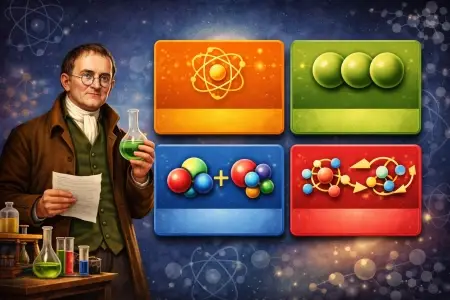
Dalton's atomic model , proposed by John Dalton in 1808, marked a turning point in modern chemistry. This model establishes how atoms constitute matter and how they interact to form compounds. In this article, we explain each of Dalton's postulates and their implications.
Overview of Dalton's atomic model
Dalton's atomic model is based on the idea that matter is made up of atoms, which are indivisible units and combine in predictable ways. Although some concepts have been modified by later discoveries (isotopes, subatomic particles), Dalton's postulates remain essential for understanding basic chemistry.
1. Elements are made up of indivisible atoms
Dalton postulated that each chemical element is composed of indivisible and indestructible atoms , which constitute the fundamental unit of matter.
-
They cannot be broken down into smaller particles by normal chemical reactions.
-
They are the basis of all substance.
Today we know that atoms have electrons, protons, and neutrons, but this postulate was key to advancing atomic theory.
2. Atoms of the same element are identical
Each atom of the same element possesses identical properties , such as mass and size.
-
It allows predicting the exact proportion of elements in compounds.
-
Explain the law of definite proportions : for example, water (H₂O) always contains 2 hydrogen atoms for every 1 oxygen atom.
Later it was discovered that isotopes exist, atoms of the same element with different masses.
3. Atoms of different elements combine to form compounds
Dalton explained that atoms of different elements can combine in fixed proportions to form chemical compounds:
-
Each compound has a constant composition.
-
Reactions always occur in a predictable manner.
For example, carbon and oxygen can form:
-
Carbon monoxide (CO) : 1 atom of C + 1 atom of O
-
Carbon dioxide (CO₂) : 1 atom of C + 2 atoms of O
This underlies the law of multiple proportions, formulated by Dalton himself.
4. Chemical reactions involve the rearrangement of atoms
In any chemical reaction:
-
Atoms are neither created nor destroyed , they are only rearranged.
-
This supports Lavoisier's law of conservation of mass .
Although atoms can be broken down in nuclear reactions, for conventional chemistry, this principle remains valid.
Summary of Dalton's 4 postulates
| Postulate | Explanation |
|---|---|
| Indivisibility | Atoms are small, indivisible units of matter. |
| Identity | All atoms of the same element are identical. |
| Combination | Atoms of different elements form compounds in fixed proportions. |
| Reactions | Atoms are rearranged, not created or destroyed, during chemical reactions. |
FAQ – Frequently Asked Questions
What are the 4 postulates of Dalton's atomic model?
-
Elements are made up of indivisible atoms.
-
Atoms of the same element are identical.
-
Atoms of different elements combine to form compounds.
-
Chemical reactions rearrange atoms without destroying them.
What contributions did Dalton make to chemistry?
Dalton explained the structure of matter , the laws of definite proportions , and how atoms combine in specific ratios . His theory allowed for a more systematic study of chemical reactions.
How many of Dalton's postulates are there?
There are 4 main postulates in his atomic model.
What is the atom like according to Dalton?
For Dalton, the atom is an indivisible , homogeneous particle without internal structure, which constitutes all chemical elements.
Conclusion
Dalton's postulates remain fundamental in chemistry education. Although modern physics has refined his theory, the idea that atoms form the basis of matter and combine in definite proportions remains valid. To learn more about Dalton's complete model and its limitations .